Encouraging Bear,
called Horn Chips
A wičháša wakȟáŋ — holy man — of the Oglala Lakota, raised alongside Crazy Horse and known through his life as his spiritual advisor. He is remembered for the medicine he made for Crazy Horse in battle, for keeping the location of his grave, and for carrying the yuwipi healing tradition through the reservation era into a family line of holy men that continues today.
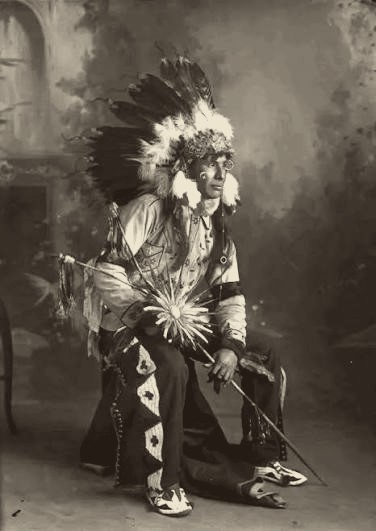
A man of several names
He is recorded under more names than most figures of his era — a mix of Lakota descriptive naming, English translation, and names taken on later in life. Some are firmly attested in the historical and ethnographic record; others come down through family and community memory.
His Lakota name, most often rendered in English sources as "Horn Chips" or "Buffalo Horn Chips." The name is said to describe the splinters of black horn that fly off when two buffalo bulls clash heads in a fight.
An alternate English rendering used in the historical record and in his modern biographical entry, distinct from the more common "Horn Chips" translation.
The name used most consistently across ethnographic accounts of the period, and the one his sons and grandsons carried forward — his son Charles was known as Charles Horn Chips.
A name attached to him in family and community memory, alongside "His Leggings." These appear less consistently in the published ethnographic record than "Horn Chips" or "Wóptuȟ'a."
A life alongside Crazy Horse
What is documented of his life is inseparable from his role beside the war leader Crazy Horse — the two were raised together, and Chips's medicine and counsel followed Crazy Horse through the resistance years and to his death.
Born near Fort Teton
Orphaned as a young child and raised by his grandmother before being adopted by an uncle of Crazy Horse — the beginning of a lifelong bond between the two men, raised together from childhood.
Spiritual advisor to Crazy Horse
Served as Crazy Horse's medicine man through the years of the Lakota resistance, credited in the record with the gift of prophecy and the ability to locate lost people and objects and to influence weather — reputation attested in period accounts rather than independently verifiable.
Present at Crazy Horse's death
Chips was at Camp Robinson when Crazy Horse was killed; when a soldier withdrew the bayonet, its butt struck and dislocated his shoulder. He went on to bury Crazy Horse and was, by his own account, the only person who knew the location of the grave.
Interviewed on Crazy Horse
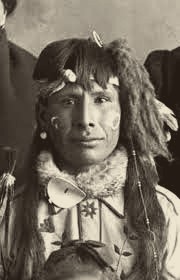
Interviewed about his years with Crazy Horse — the source of the photographic record of him and his wife from this period, and part of the same wave of early-1900s interviews that preserved firsthand Lakota accounts of the resistance era.
Death
Sources differ on the year of his death, giving either 1913 or 1916. He is reported to have taken up Catholicism shortly before he died, after a lifetime as a keeper of Lakota tradition. He was survived by a wife and four children.
What he carried forward
Beyond his role with Crazy Horse, Wóptuȟ'a is remembered in Lakota religious history for something larger: he is credited with helping carry traditional Lakota religion through the era when it was under direct legal threat. From 1883 to 1934, the U.S. Indian Religious Crimes Code made Lakota ceremony punishable by imprisonment. Practitioners of that period held their traditions in secret, and Wóptuȟ'a is remembered among the Oglala as one of those who kept the altar lit.
He is closely associated with the spread of the yuwipi ceremony — a Lakota healing rite in which the medicine man is ritually bound and calls on spirit helpers on behalf of someone in need of healing. Ethnographic and community sources trace much of the modern Oglala yuwipi tradition back through his altar.
His descendants carried the work forward directly. According to the Moves Camp family's own published account, his sons James Moves Camp and Charles Horn Chips, his grandson Sam Moves Camp, and his great-great-grandson Richard Moves Camp each became recognized Lakota holy men in turn — five generations, by the family's own reckoning, from one altar.
The Wóptuȟ'a line, by family account
- Wóptuȟ'aEncouraging Bear / Horn Chips — spiritual advisor to Crazy Horse
- James Moves Camp & Charles Horn ChipsSons; carried the altar into the 20th century
- Sam Moves CampGrandson
- Richard Moves CampGreat-great-grandson; contemporary Oglala healer and tribal historian, Sinté Glešká University
Reading the record
This page separates what appears in the published historical and ethnographic record from what is preserved primarily through family and community tradition. Both are legitimate ways of knowing this history — they are simply different kinds of evidence, and this site tries not to blur them.
Documented record
- Role as Crazy Horse's spiritual advisor and childhood companion
- Presence at and account of Crazy Horse's death at Camp Robinson, 1877
- 1907 interview on his life with Crazy Horse
- Association with the spread of the yuwipi ceremony
- Death recorded as 1913 or 1916, sources disagree
Family & community tradition
- Reputation for prophecy, weather-calling, and finding the lost
- Names "Tahunska" and "His Leggings"
- Details of the Crazy Horse / Black Buffalo Woman episode
- Specific medicine objects (wotawe) attributed to him
- Full five-generation family narrative, as told in My Grandfather's Altar
Sources
-
"Encouraging Bear." Wikipedia. Primary biographical summary used for this page's documented-record claims.
-
"Yuwipi." Wikipedia. Background on the healing ceremony associated with his religious legacy.
-
Moves Camp, Richard, with Simon Joseph and Jennifer Jessum, eds. My Grandfather's Altar: Five Generations of Lakota Holy Men. University of Nebraska Press, 2024. The family's own published account of the Wóptuȟ'a lineage.
-
"Life of Crazy Horse Chronology." Sioux Replications. Community-sourced narrative detail on the Wóptuȟ'a / Crazy Horse relationship.
-
National Park Service, Little Bighorn Battlefield. "Crazy Horse (Tȟašúŋke Witkó)." Corroborating context on Crazy Horse's life and death.